> For the complete documentation index, see [llms.txt](https://docs.datasaur.ai/llms.txt). Markdown versions of documentation pages are available by appending `.md` to page URLs; this page is available as [Markdown](https://docs.datasaur.ai/advanced/extensions/labels.md).
# Labels
Manage and apply label sets.
The **Labels** extension displays the label set configured during project creation and allows users to apply labels to spans directly within the document.
It is available for span labeling projects (including projects combined with line labeling or document labeling) and conversational labeling projects.
## Label set modification
You can manage label sets from either the **Label Management** page in your workspace or directly within a project. This includes adding, editing, and removing label sets.Learn more in the [label set management](/workspace-management/label-management/label-set-management.md) documentation.
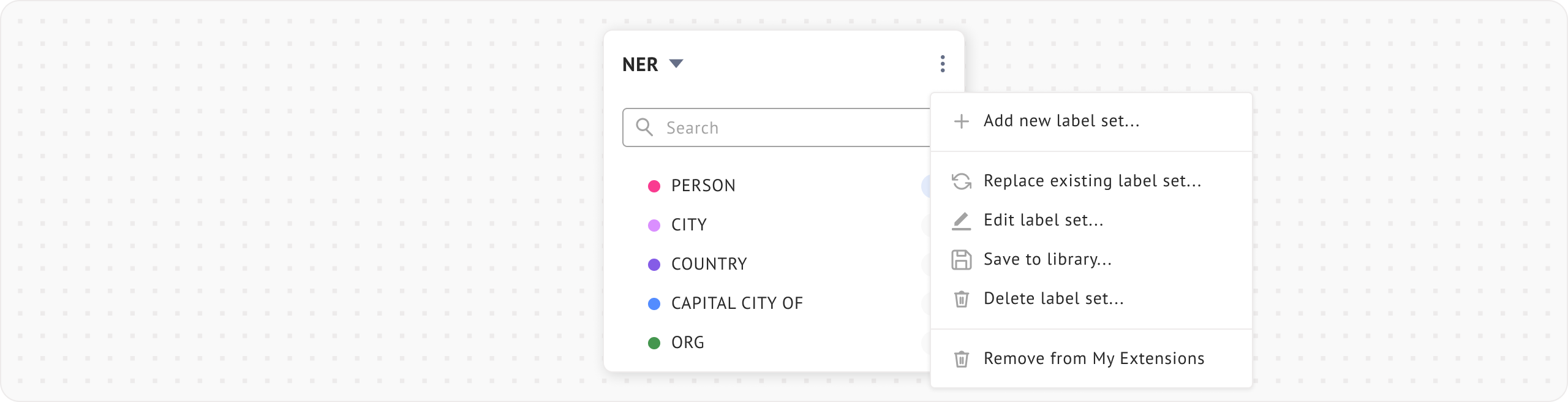
Within a project, open the three-dot menu in the extension to modify the label set.
### Add a new label set
If your project has multiple focuses or tasks, you can add additional label sets. Adding a new label set does not affect existing label sets. You can add it in three ways:
* Upload a `.csv` or `.tsv` file.
* Select a label set from the library.
* Create labels manually.
The library includes the following default label sets:
* INACL.
* Stanford.
* Default NER.
Previously used label sets are also automatically added to the library.
### Replace existing label set
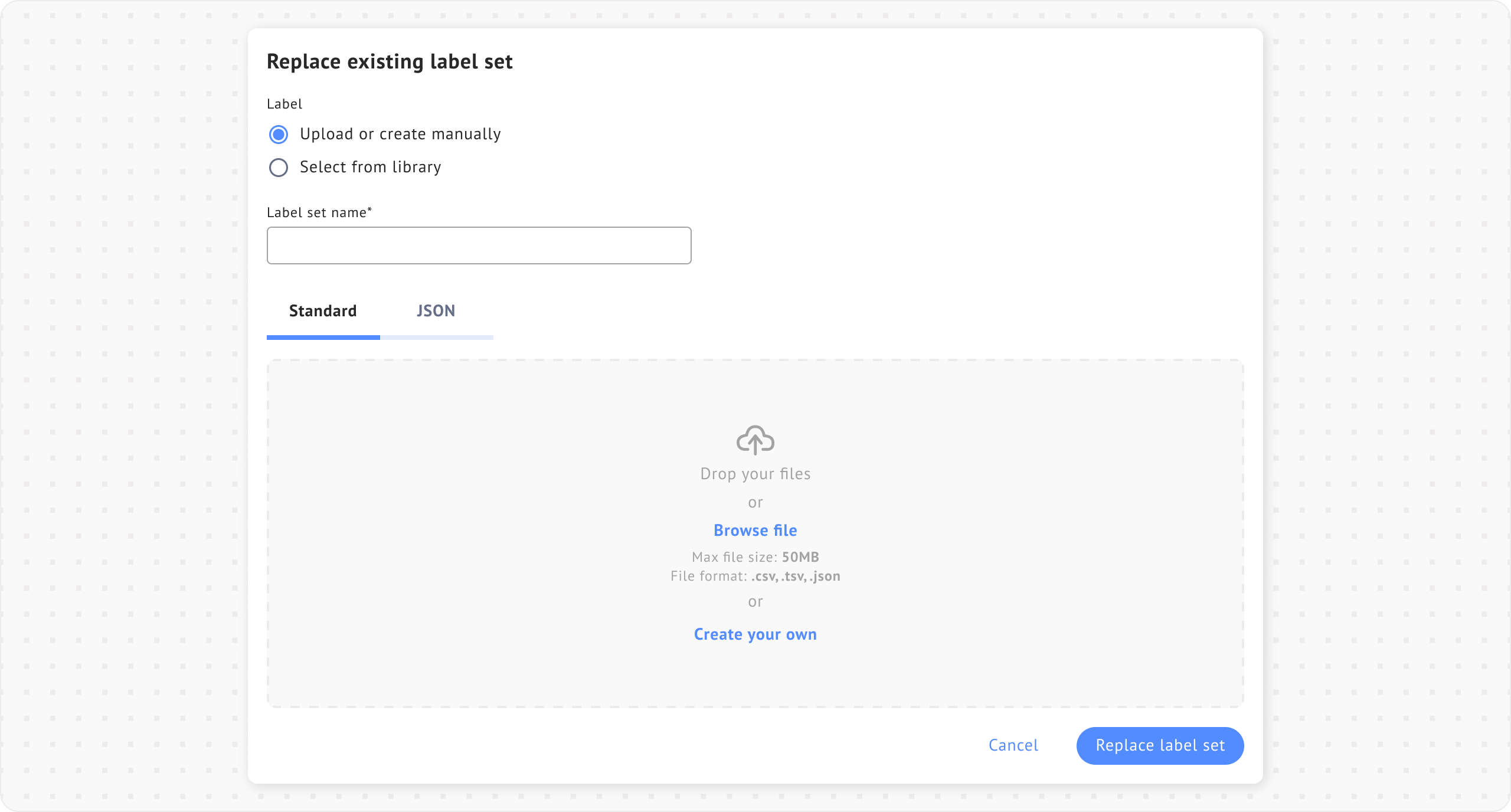
To replace existing label set, you can upload a new label set, create one manually, or select one from the library.
{% hint style="info" %}
Replacing a label set removes all labels applied from the previous label set.
{% endhint %}
### Edit label set
After the project is created, you can add new labels, edit existing ones, or remove them. Here are the [label set properties](/workspace-management/label-management/label-set-management.md#label-set-management-page) you can edit.
{% hint style="info" %}
Changes made inside a project do not automatically update the corresponding label set in the **Label management** page.
{% endhint %}
#### Add labels
To add new labels to existing label set, you can type it in the **Label class** field and select a label color.
You can reorder labels by dragging them using the handle icon. To create a hierarchical label set, drag a label slightly to the right to nest it under another label. Label hierarchies support up to 10 levels.
#### Edit labels
You can edit existing labels in a label set. You can change the label class name, label color, label class clarification, and label position.
### Delete label set
You can delete a label set from the three-dot menu. Deleting a label set will remove all applied labels from that label set.
### Save to library
You can save the current label set to your library (**Label management** page) for reuse in other projects.
## Show instances by label class
The **Labels** extension tracks all labels applied to spans and arrows. Click the instance counter to view all instances for a label class.
Clicking an instance navigates directly to its location in the text viewer.

## Mark unapplied label classes as not applicable
Some label classes may not apply to every document. To communicate this, labelers can mark these label classes as **N/A (Not applicable)**. Labelers can only do this when the feature is enabled.
### Enable the feature
To enable it during project creation, proceed to step 5.

To enable it in existing projects, go to **File >** **Settings** and open the **Administrator** tab.

### Mark a label class as N/A
A label can be marked as N/A only if it has not been used in the document yet. Labels eligible for N/A display an instance count of `0`.
To mark a label class as N/A, click on the instance counter.
{% hint style="info" %}
* Applying the label later automatically removes the N/A mark.
* N/A marks are visible only to the labelers who marked them.
{% endhint %}
To remove the N/A mark, click the instance counter again.
## Review unapplied label classes
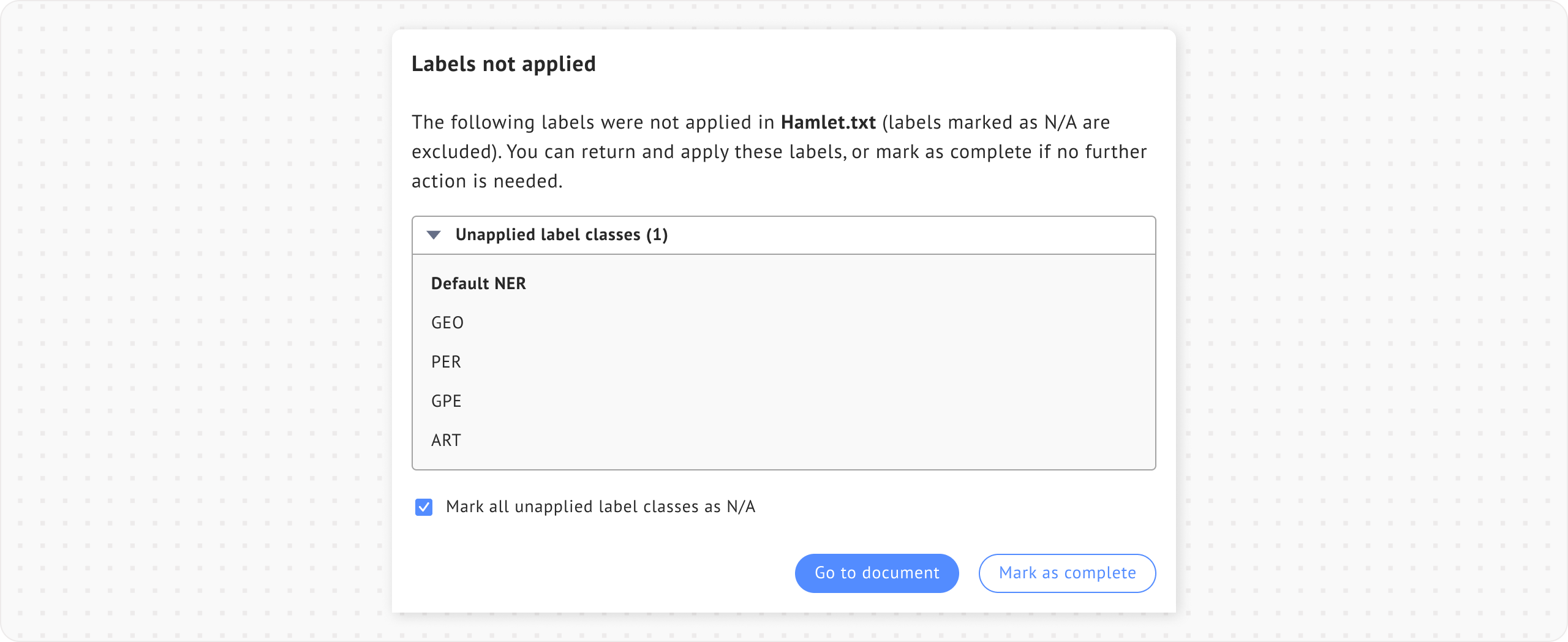
When you mark a document as complete, a dialog will appear. If there are unapplied label classes, the dialog will display those labels classes.
To mark all remaining unapplied label classes as N/A, check the **Mark all unapplied label classes as N/A** option, then click **Mark as complete**.

.png?alt=media)
.png?alt=media)