# LLM Assisted Labeling

{% hint style="info" %}
**Supported labeling types**: Span labelin&#x67;**,** row labeling.
{% endhint %}

**LLM Assisted Labeling** allows you to use models from OpenAI, Azure OpenAI, Anthropic, Gemini, and Cohere to assist with labeling. This helps make labeling easier across different use cases.

## Providers and model support

<table><thead><tr><th width="146.5625">Provider name</th><th>Model</th></tr></thead><tbody><tr><td>OpenAI</td><td>gpt-3.5-turbo, gpt-4, gpt-4-turbo, gpt-4o, gpt-4o-mini</td></tr><tr><td>Azure Open AI</td><td></td></tr><tr><td>Anthropic</td><td>claude-2, claude-2.1, claude-3-haiku-20240307, claude-3-opus-20240229, claude-3-sonnet-20240229, claude-3-5-sonnet-20240620</td></tr><tr><td>Gemini</td><td>gemini-pro, gemini-1.5-flash, gemini-1.5-pro</td></tr><tr><td>Cohere</td><td>command-light, command-r, command-r-plus</td></tr><tr><td>Custom</td><td>Support for any LLM Provider without requiring additional coding for Row Labeling.</td></tr></tbody></table>

## Quick guide

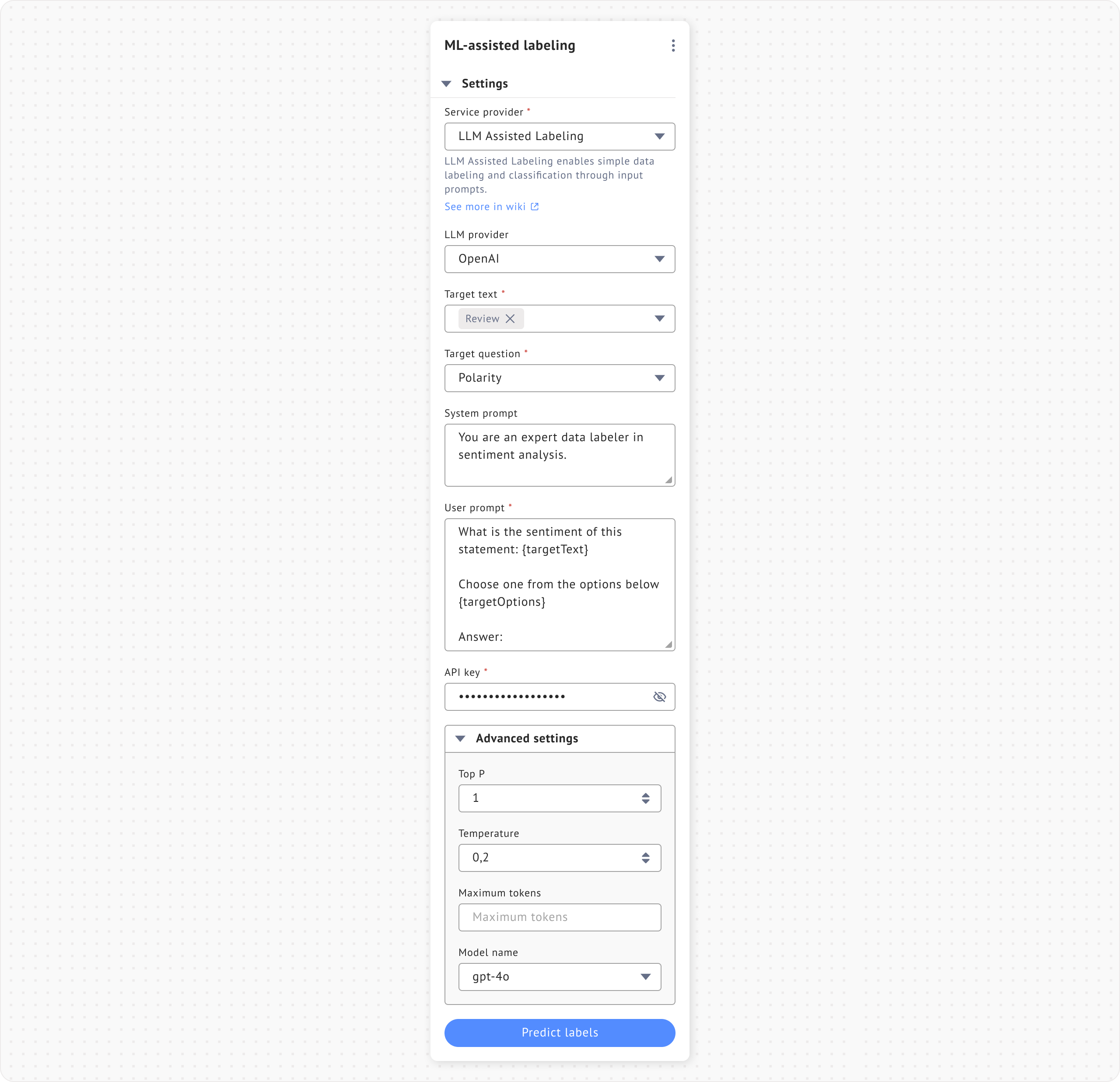
After creating the project, enable the **ML-assisted labeling** extension and select **LLM Assisted Labeling** as the provider. The following fields will be available:

<figure><img src="/files/Dbo2Klur0Lptal1nz5JA" alt="Image of Empty Row Based Project"><figcaption></figcaption></figure>

{% hint style="info" %}
For custom providers, refer to the dedicated [page](/assisted-labeling/ml-assisted-labeling/llm-assisted-labeling/custom-provider.md).
{% endhint %}

1. **LLM provider**: Select a supported LLM provider.
2. **Target text**: Select Input column(s) that will be used as context.
3. **Target question**: Select a question to be answered.
4. **System prompt**: Define the model’s behavior and context.
5. **User prompt**: Defines the task for the model.
6. **API key**: Add the LLM provider secret key.
7. **For Azure OpenAI**
   1. **API version:** Enter the API version from your Azure OpenAI.
   2. **API base URL**: Enter the base URL for your Azure OpenAI API model.
   3. **Model deployment:** Enter the deployment model name from Azure OpenAI.
8. **Advanced settings**
   1. **Top P**: Limits predictions to the smallest set with a cumulative probability of P.
   2. **Temperature**: Controls randomness; lower values make responses more predictable.
   3. **Maximum tokens**: Limits the length of the generated response.
   4. **Model name**: The specific version of the language model.

{% hint style="info" %}
For guidance, you can refer to our prompt examples: [row labeling](/assisted-labeling/ml-assisted-labeling/llm-assisted-labeling/prompt-examples.md#row-labeling) and [span labeling](/assisted-labeling/ml-assisted-labeling/llm-assisted-labeling/prompt-examples.md#span-labeling).
{% endhint %}

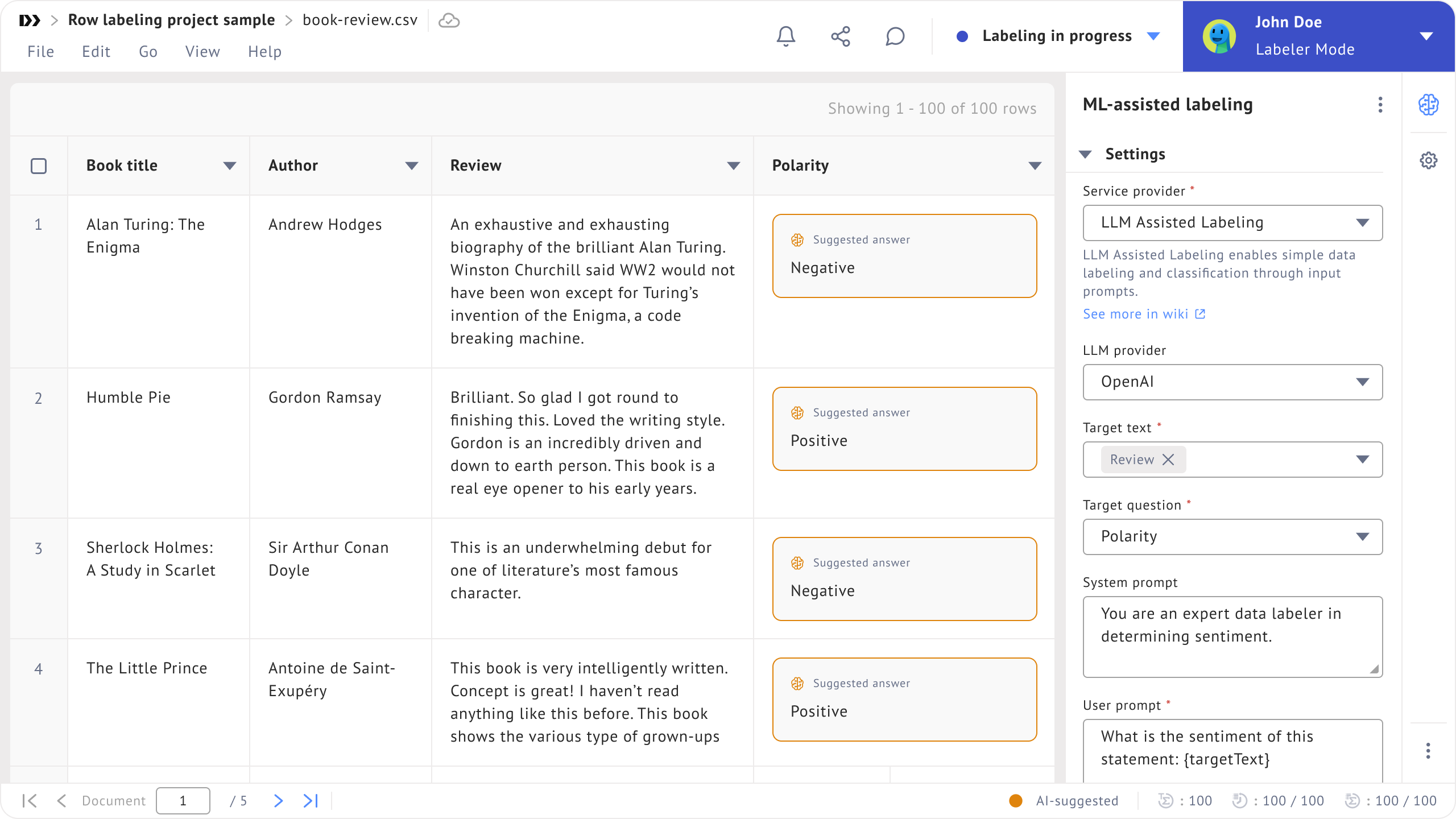
After completing the configuration, click **Predict labels** to generate labeling suggestions.

<figure><img src="/files/CRZlIS3Ao074YMShwRxr" alt="Image of Prediction Result"><figcaption></figcaption></figure>

{% hint style="info" %}
A 429 error indicates rate limits from the LLM provider. Check your API usage and limits.
{% endhint %}


---

# Agent Instructions: Querying This Documentation

If you need additional information that is not directly available in this page, you can query the documentation dynamically by asking a question.

Perform an HTTP GET request on the current page URL with the `ask` query parameter:

```
GET https://docs.datasaur.ai/assisted-labeling/ml-assisted-labeling/llm-assisted-labeling.md?ask=<question>
```

The question should be specific, self-contained, and written in natural language.
The response will contain a direct answer to the question and relevant excerpts and sources from the documentation.

Use this mechanism when the answer is not explicitly present in the current page, you need clarification or additional context, or you want to retrieve related documentation sections.