> For the complete documentation index, see [llms.txt](https://docs.datasaur.ai/llms.txt). Markdown versions of documentation pages are available by appending `.md` to page URLs; this page is available as [Markdown](https://docs.datasaur.ai/llm-projects/knowledge-base/periodic-sync.md).
# Periodic Sync
## Overview
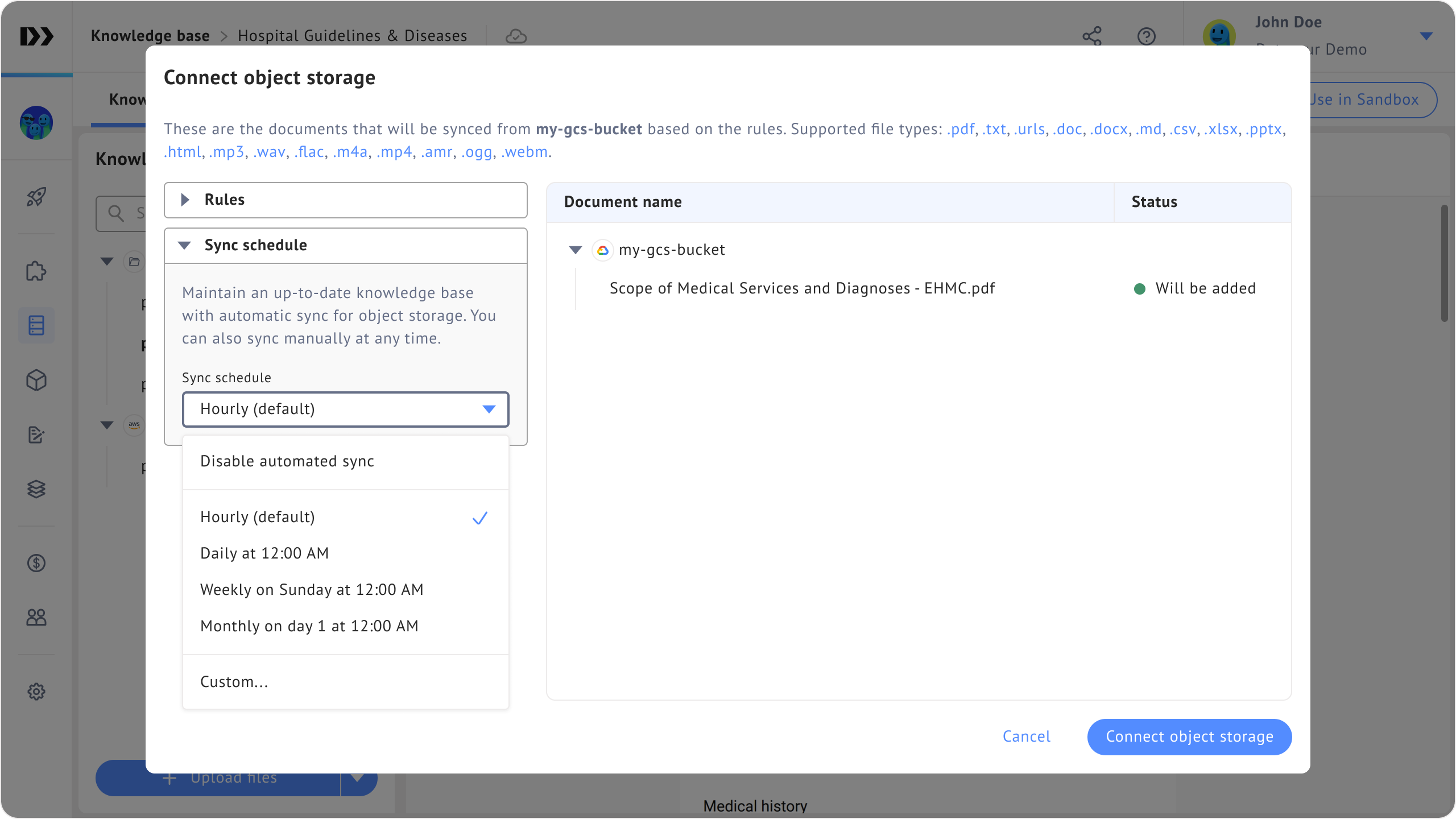
Your knowledge bases can now stay in sync with your external object storage (AWS S3, Google Cloud Storage, Azure Blob Storage) through the periodic sync feature. It ensures your knowledge base is always updated without manual effort.
By default, knowledge bases will **sync every hour** to import new or updated documents and remove outdated ones according to your rules.
## Configuration
1. Navigate to the **Sync schedule** section during external object storage setup.
2. Choose **Custom** to customize automatic synchronization.
3. Choose **Disable automated sync** if you prefer only manual updates.
4. Click **Save and update** once you have configured the schedule.
## Monitor synchronization status and schedule
For each external object storage, a **sync status** icon is shown. Hover over the icon to see the last sync date.
The popover provides the following information:
* **Last sync:** The time of the most recent successful sync.
* **Next Sync:** The scheduled time of the next automatic sync.
You can also do the following:
* **Sync now:** Start an immediate, on-demand sync. It's useful for pulling in critical updates outside the regular schedule.
* **Edit schedule:** Open the settings to change how often automatic sync runs.