> For the complete documentation index, see [llms.txt](https://docs.datasaur.ai/llms.txt). Markdown versions of documentation pages are available by appending `.md` to page URLs; this page is available as [Markdown](https://docs.datasaur.ai/workspace-management/activity.md).
# Activity
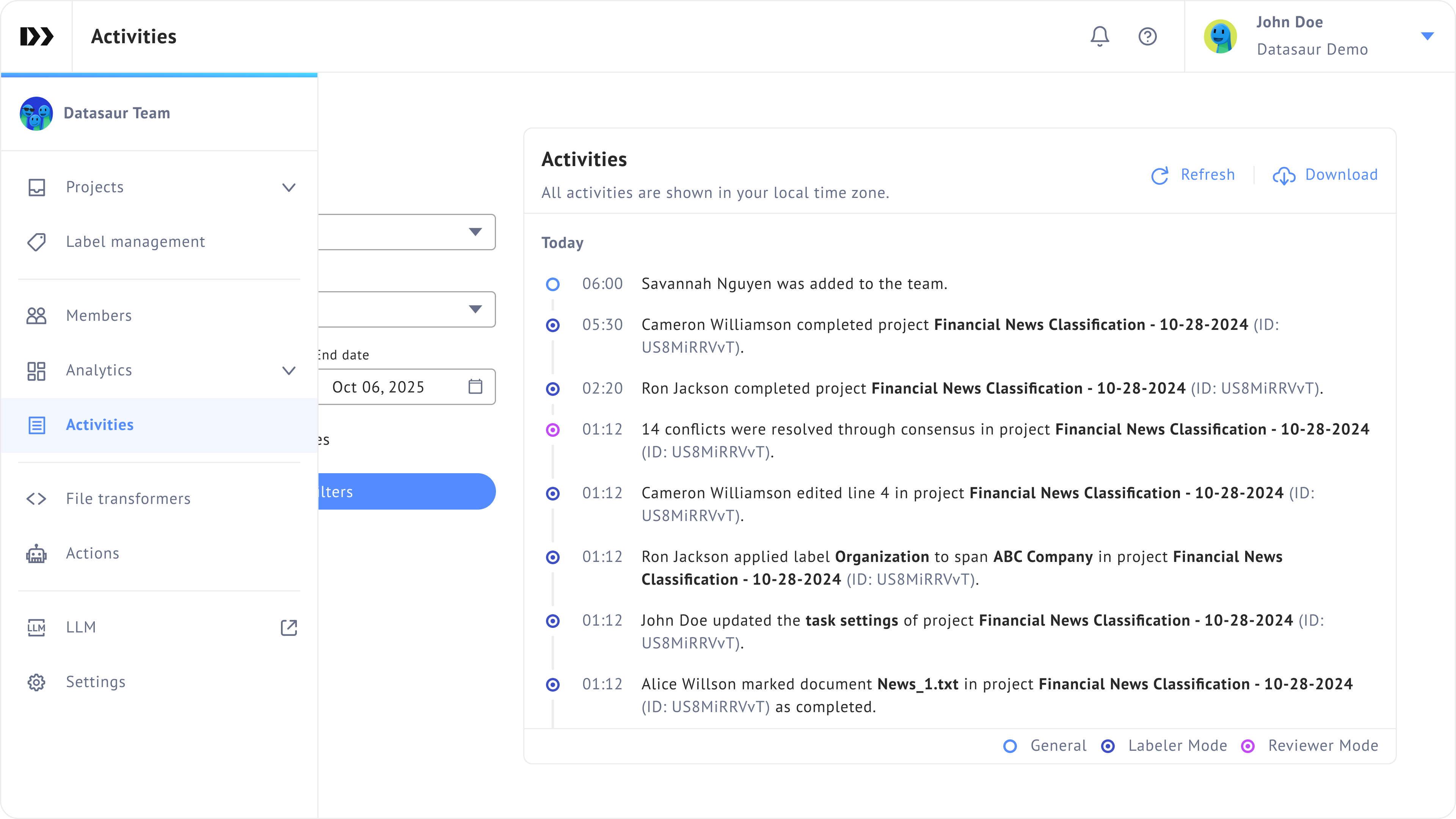
The **Activity** page tracks all kinds of actions within a workspace.
## Tracked activities
### Project lifecycle
1. **Project creation:** When a member creates a project.
2. **Project rename:** When a member renames a project.
3. **Initial project access:** The first time a member opens a project in labeler mode or reviewer mode.
4. **Project status changes:** Each time a reviewer changes the status in reviewer mode.
5. **Labeling status changes:** Each time a labeler changes the status of a project in labeler mode.
6. **Project export:** When an entire project (all documents) is exported.
7. **Project archive or restore:** When a member archives or restores a project.
8. **Project deletion:** When a member deletes a project.
9. **Document export:** When a specific document is exported from a project.
10. **Document addition:** When documents are added to an existing project.
11. **Labeling guideline update:** When a member adds or modifies the labeling guideline.
12. **Project configuration changes:** When a member modifies the assignment, task settings, or admin settings of a project.
### Labeling activities
#### Span labeling, conversational labeling, bounding box labeling
1. **Single label application:** When a member applies a label manually, it counted separately for each member in labeler mode and reviewer mode.
2. **Multiple label application:** When a member applies labels using extensions (ML-assisted labeling, Predictive labeling, Data programming, Label error detection, and Search).
3. **External label acceptance or rejection:** When a member accepts or rejects labels from extensions (ML-assisted labeling, Predictive labeling, Data programming, Label error detection, and Search).
4. **Label update:** When a member updates a label. In reviewer mode, this is counted only if the label is not conflicted.
5. **Label deletion:** When a member deletes a label.
6. **Conflict resolution:** When a reviewer accepts or rejects a conflicted label. Changing a conflicted label to another is recorded as two actions: label rejection followed by label application.
7. **Sentence update:** When a member modifies the data.
#### Row labeling, document labeling
1. **Single answer submission:** When a member submits answer.
2. **Multiple answer submission:** When a member submits answers using extensions (ML-assisted labeling, Predictive labeling, Data programming, Label error detection, and Search).
3. **External answer acceptance or rejection:** When a member accepts or rejects answers from extensions (ML-assisted labeling, Predictive labeling, Data programming, Label error detection, and Search).
4. **Answer update:** When a member updates an existing, non-conflicting answer.
5. **Conflict resolution:** When a reviewer resolves conflicts in answers.
## Filter
1. **Project:** View all projects or filter by a specific project.
2. **Member:** View all member activity or filter by a specific member.
3. **Date range:** Use UTC time zone to group activities by day.
4. **Show or hide labeling activities:** Toggle to include or exclude detailed [labeling activities](#labeling-activities).
## Download the activity report
Click **Download** at the top right of the page to export the activity report in `.csv` format. The exported report includes tracked activities with the following details:
1. **Timestamp:** The date and time when the activity occurred.
2. **User ID:** The unique identifier of the member who performed the activity.
3. **Display name:** The name of the member who performed the activity.
4. **Email:** The email address of the member who performed the activity.
5. **Mode:** The mode in which the activity was performed (labeler mode or reviewer mode). If it's not a labeling activity, it will be categorized as **General**.
6. **Project ID:** The unique identifier of the project where the activity occurred.
7. **Project name:** The name of the project where the activity occurred.
8. **Document ID:** The unique identifier of the document associated with the activity.
9. **Document name:** The name of the document associated with the activity.
10. **Action:** The specific action taken by the member. This includes workspace-level actions (for example, creating a project) and project-level actions (for example, creating a label).
11. **Additional data:** Extra information not captured in other columns, stored in `.json` format.