> For the complete documentation index, see [llms.txt](https://docs.datasaur.ai/llms.txt). Markdown versions of documentation pages are available by appending `.md` to page URLs; this page is available as [Markdown](https://docs.datasaur.ai/data-studio-projects/lets-get-labeling/label-sets/dynamic-question-set.md).
# Dynamic Question Set
A dynamic question set lets you show or hide questions based on answers to other questions.
You can set up this logic when [creating a project](/data-studio-projects/creating-a-project.md#step-3-labeler-tasks-sharpvartagopen-if-renderprojectcreationtutorialvideolink-vartagclose-video-tut)[ ](/data-studio-projects/creating-a-project.md#step-3-labeler-tasks-sharpvartagopen-if-renderprojectcreationtutorialvideolink-vartagclose-video-tut)or from the [Question set management](/workspace-management/label-management/question-set-management.md) page. To set it up:
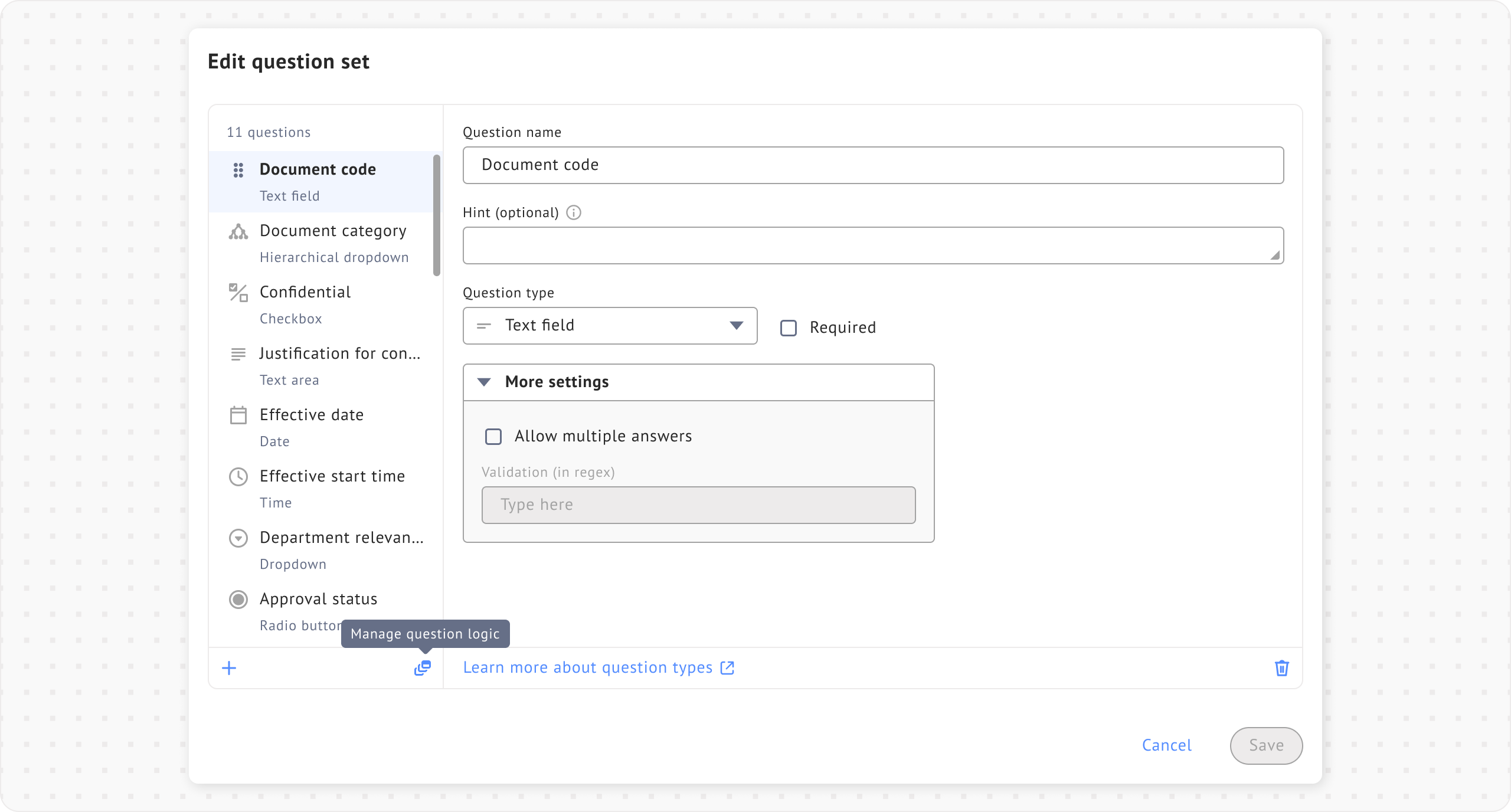
1. Click **Manage question logic** icon located at the bottom right of the question list area.
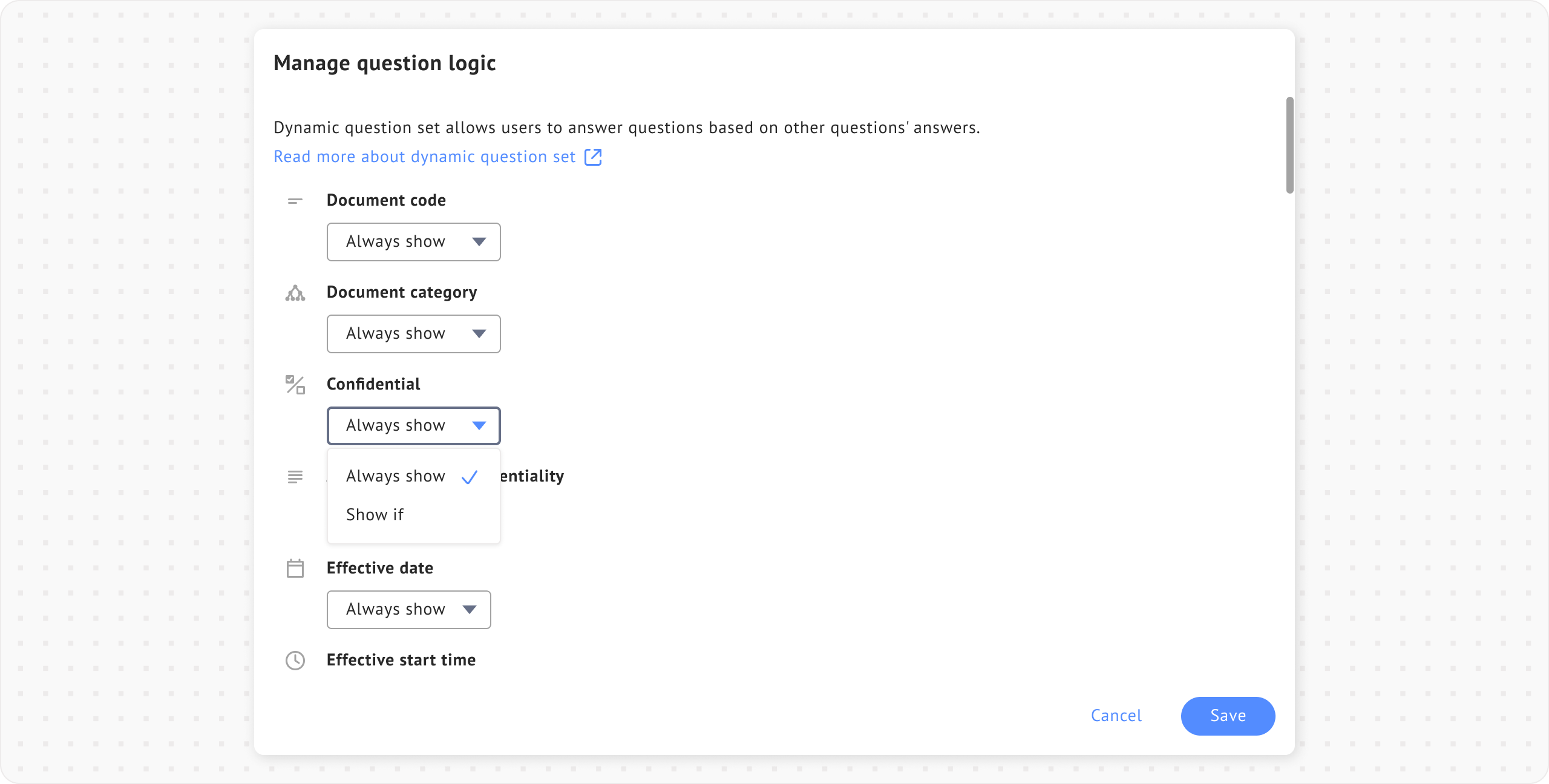
2. Define the logic.
1. **Always show:** The question is always shown and does not depend on other answers.
2. **If:** The question is shown only when specific conditions are met.
## Rule details
### **Comparison rule**
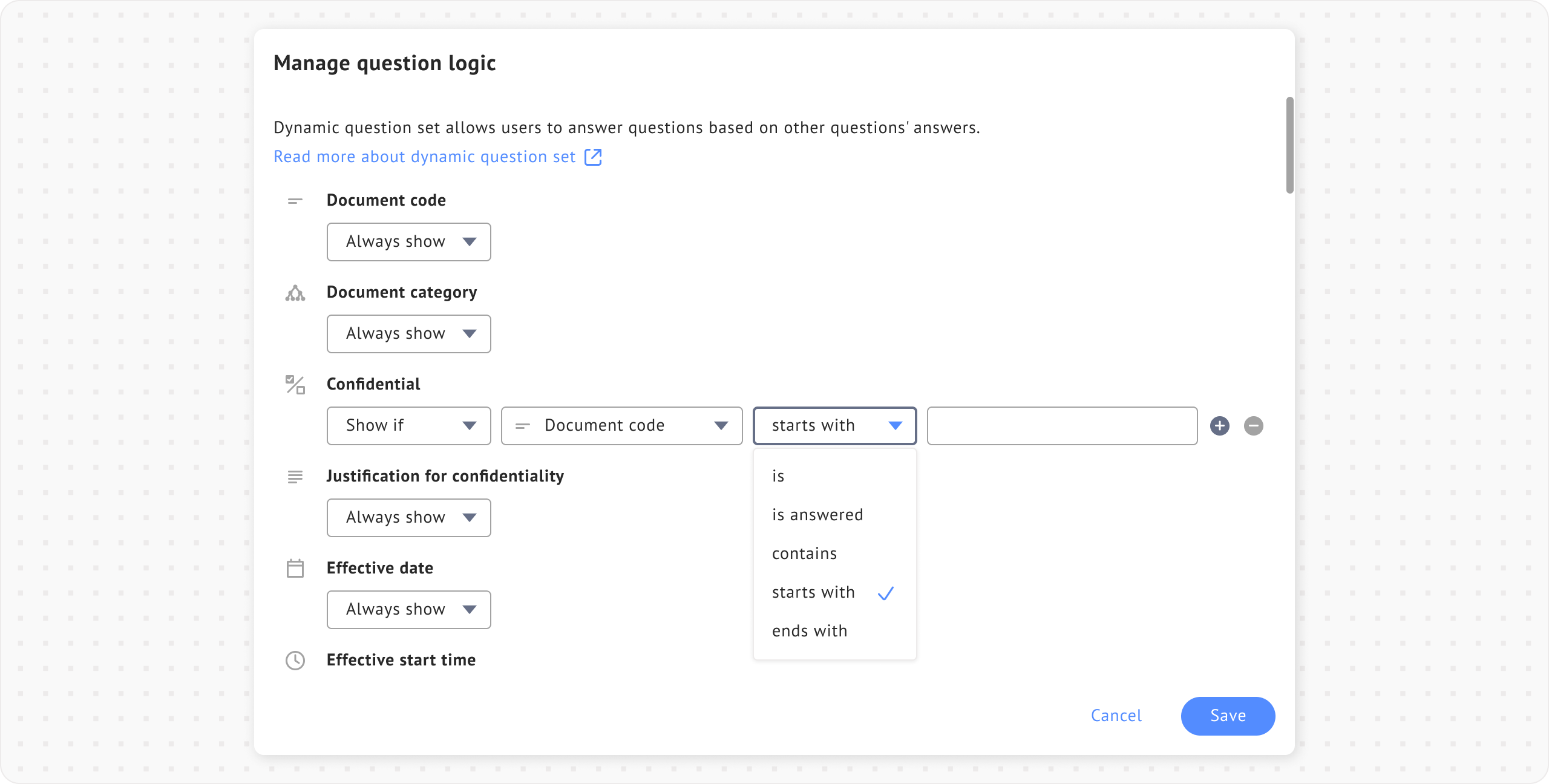
Each question type supports specific comparison rules, which let you define conditions based on the answer type.
#### Common rules
* `is`: Checks if the answer exactly matches a value.
* `is answered`: Checks whether the question has been answered.
* `contains`: Checks whether the answer includes a specific keyword.
* **Single answer**: Checks if the keyword is part of the answer (Example: `run` is a substring of `running`).
* **Multiple answers**: Checks for an exact match (Example: `run` exactly matches `run`).
* `starts with / ends with` : Checks whether the answer begins or ends with specific text.
* `is checked / is unchecked`: Checks whether a checkbox is selected or not.
**Examples:**
* Text question
* **Q1**: A text question with a single answer
* **Q2**: A text question with logic applied: `Q1 CONTAINS run`.
* If you answer **Q1** with `Marathon run` or `running outside`, **Q2** will be activated.
* Dropdown question
* **Q1**: A dropdown question with a single answer
* **Q2**: A text question with logic applied: `Q1 CONTAINS run.`
* If you select `Marathon run` or `running outside` in **Q1**, **Q2** will be activated.
#### Numeric rules
* `> / <`: Checks if a value is greater or less than a specific number.
* Example:
* **Q1**: A slider question with a single answer.
* **Q2**: A text question with logic applied: `Q1 < 8`.
* If you set **Q1** to `7` or `6`, **Q2** will be activated.
* `≥ / ≤`: Checks if a value is greater than or equal to, or less than or equal to a specific number.
* Example:
* **Q1**: A slider question with a single answer.
* **Q2**: A text question with logic applied: `Q1 ≥ 8`.
* If you set **Q1** to `8`, `9`, or `10`, **Q2** will be activated.
To understand which rules apply to each question type, refer to the table below.
### **Conjunction rule**
For conditional logic, you can use two conjunctions:
* `AND`: All conditions must be true for the question to appear.
* `OR`: Only one condition needs to be true for the question to appear.