> For the complete documentation index, see [llms.txt](https://docs.datasaur.ai/llms.txt). Markdown versions of documentation pages are available by appending `.md` to page URLs; this page is available as [Markdown](https://docs.datasaur.ai/advanced/script-generated-question.md).
# Script-Generated Question
## **Overview**
{% hint style="info" %}
This feature only available in **row labeling** project and disabled by default. Please reach out to [**support@datasaur.ai**](mailto:support@datasaur.ai) if your team needs this feature, and we'll assist you!
{% endhint %}
**Script-generated questions** is an advanced question type that allows dynamic question generation based on each row’s data. Using [TypeScript](https://www.typescriptlang.org/), users can configure logic that determines which questions should appear for a given row. This flexibility makes it ideal for cases where static question sets are insufficient.
### When to Use Script-Generated Questions
* You need **dynamic questions** that change based on row data.
* You want to **automate question creation** instead of manually defining them.
* You require **custom logic** to determine which questions appear.
* You need **dropdown options that are generated based on the data in each row.**
## Configuration
### **Defining Question Identifiers**
An **identifier** is a unique representation of a question. It serves as a reference to the question type, label, and configuration, allowing the script to access and manipulate the question during execution. Before generating questions dynamically, all possible question identifiers **must be defined during project creation**.
This is configured in the **`identifiers`** section of the script.

Each identifier should have the following attributes:
* **`id`** — A unique, zero-indexed integer, signifying the relative order of the questions.
* **`label`** — A human-readable string that represents the question.
* **`type`** — The question type (i.e. text, multiple choice, date).
* Currently, all question types are supported **except** **Grouped Attributes** and **Script-Generated Questions**, with some caveats detailed [here](#limitation).
* See [this](/data-studio-projects/lets-get-labeling/label-sets.md#question-types) for more details on each question type.
* **`config.multiple`** — Configuration that allows a question to have multiple answers.
Example Configuration
Here’s an example of an identifier for a **text** question and a **multiple-choice** question.
```tsx
identifiers: Record = {
["Text Question"]: {
id: 0,
label: "Text Question",
config: { multiple: false },
type: QuestionType.TEXT
},
["Multiple Choice Question"]: {
id: 1,
label: "Multiple Choice Question",
config: { multiple: true },
type: QuestionType.MULTIPLE_CHOICE
},
};
```
### Dynamically Generating Questions
The core function that determines which questions appear is `getQuestionsForRow`. This function runs for each row in the dataset, evaluating its data and returning the appropriate questions.
{% hint style="info" %}
**Tip:** You can view available `row` and `columns` attributes in the editor by pressing **Ctrl / Cmd + Space**.
{% endhint %}
Example Usage
In the following example:
* A **text question** appears if the column `DATA` contains the word `"text"`.
* Otherwise, a **multiple-choice question** is shown, with options generated from the values in `DATA`.
```tsx
getQuestionsForRow({ row, columns }: RowContext): Question[] {
if (getCellValueByColumnLabel("DATA").includes("text")) {
return [{ ...this.identifiers["Text Question"], required: false }];
}
const options = getCellValueByColumnLabel("DATA").split(",");
return [
{
...this.identifiers["Multiple Choice Question"],
required: false,
config: {
...this.identifiers["Multiple Choice Question"],
options: options.map((o) => ({ id: o, label: o })),
},
},
];
```
Here’s how it will look once the project is created.

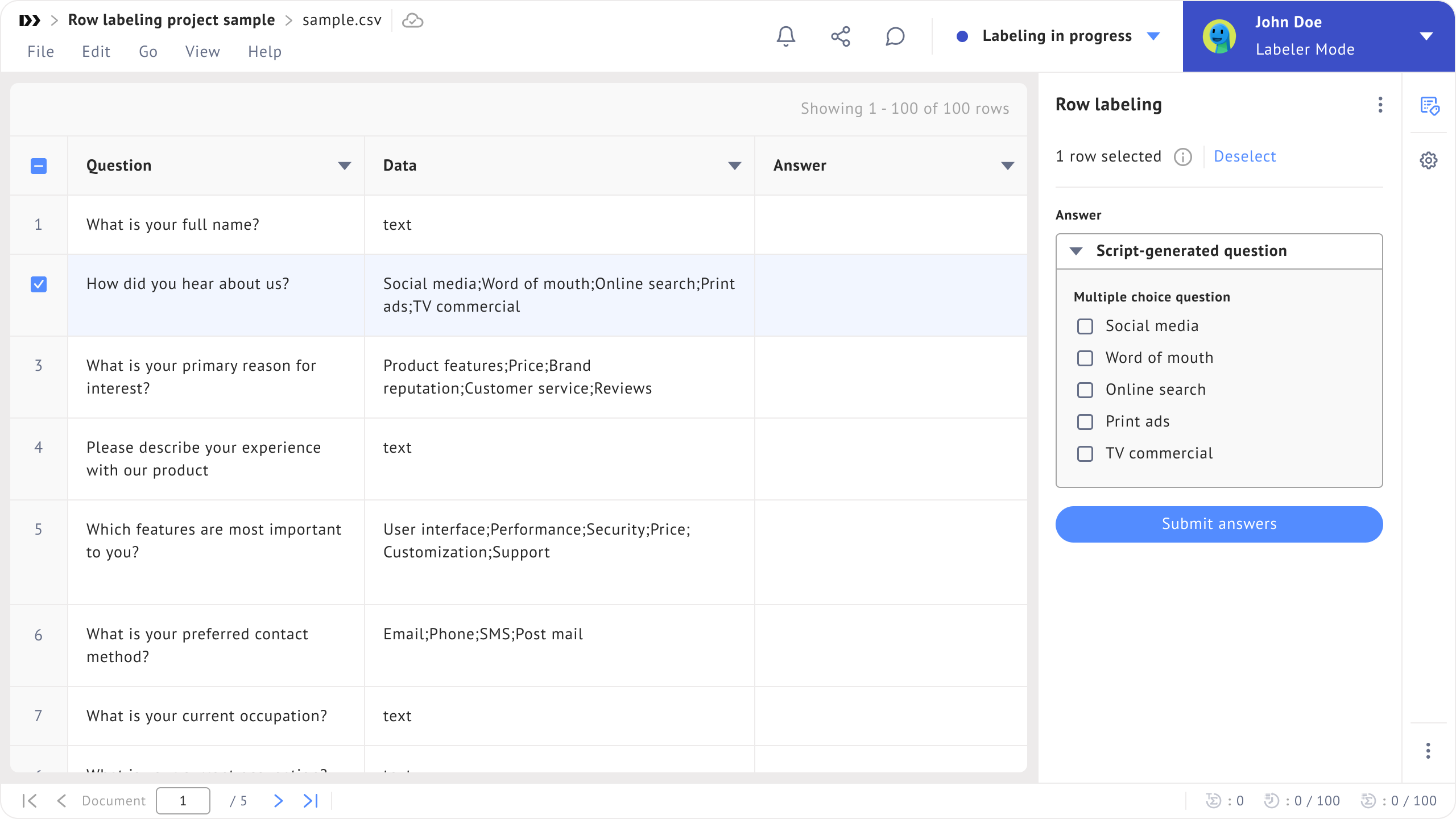
You can find a sample CSV, as well as the full script to recreate the project below.
{% file src="/files/242pkAHNwlNkpZlnUhKZ" %}
{% file src="/files/29qV2UhkOvkjUWWDhxkN" %}
## Limitation
### Dropdown and Hierarchical Dropdown
We currently **don’t support** configuring dropdown or hierarchical dropdown question types in script-generated questions.
We recommend using **multiple choice** or **single choice** question types, as these also allow users to select from a set of options.
### Question Set Management
1. Any script-generated questions **will not be saved** to the library when the question set is saved.
2. When configuring the question set in **Label set management**, these questions **will not appear** in the question type dropdown.
### Question Logic
Since question logic relies on a predefined order, it’s not currently possible to configure logic for questions that reference a script-generated one. This is because script-generated questions are created dynamically during the project, which makes it difficult to set conditions for subsequent questions based on them.
What this means is that questions following a script-generated one can still have logic, but they can only reference other question types, not the script-generated question itself.