> For the complete documentation index, see [llms.txt](https://docs.datasaur.ai/llms.txt). Markdown versions of documentation pages are available by appending `.md` to page URLs; this page is available as [Markdown](https://docs.datasaur.ai/workspace-management/analytics/project-report.md).
# Project Report
See the summary of the labeling work for a specific project
## Summary dialog
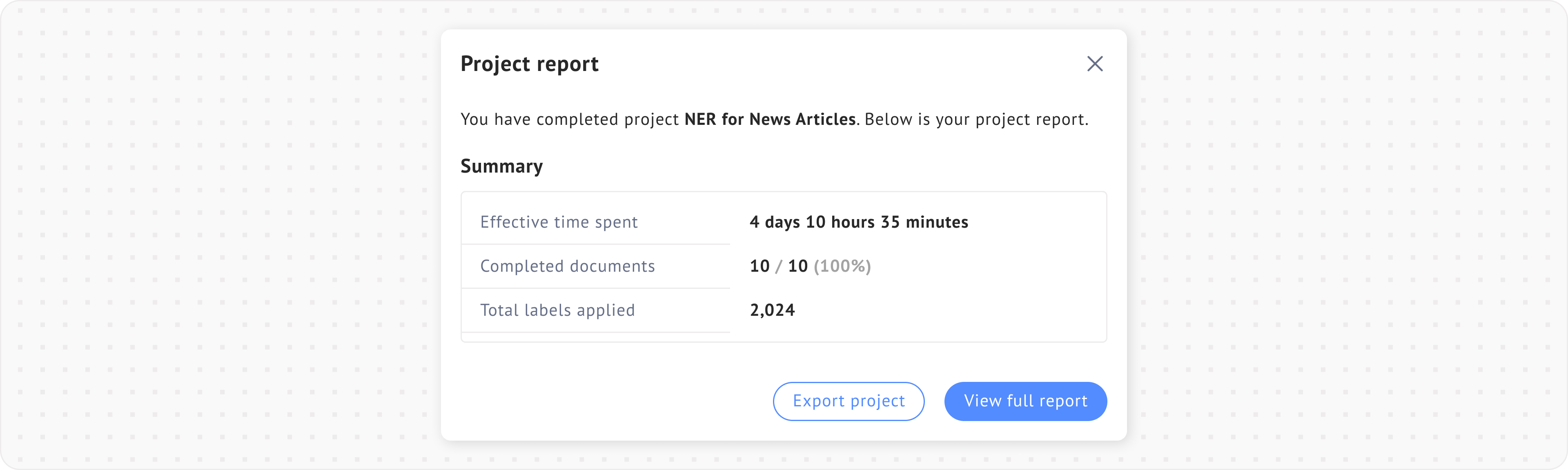
When a project is completed in reviewer mode, a summary dialog displays key metrics summarizing the labeling results. This feature is accessible only to **admins** and **supervisors**.
You can also export the project or view the full report from this dialog.
If you frequently reopen a completed project, you can choose not to show the summary dialog again for that project.
## Report tab in Project Analytics page
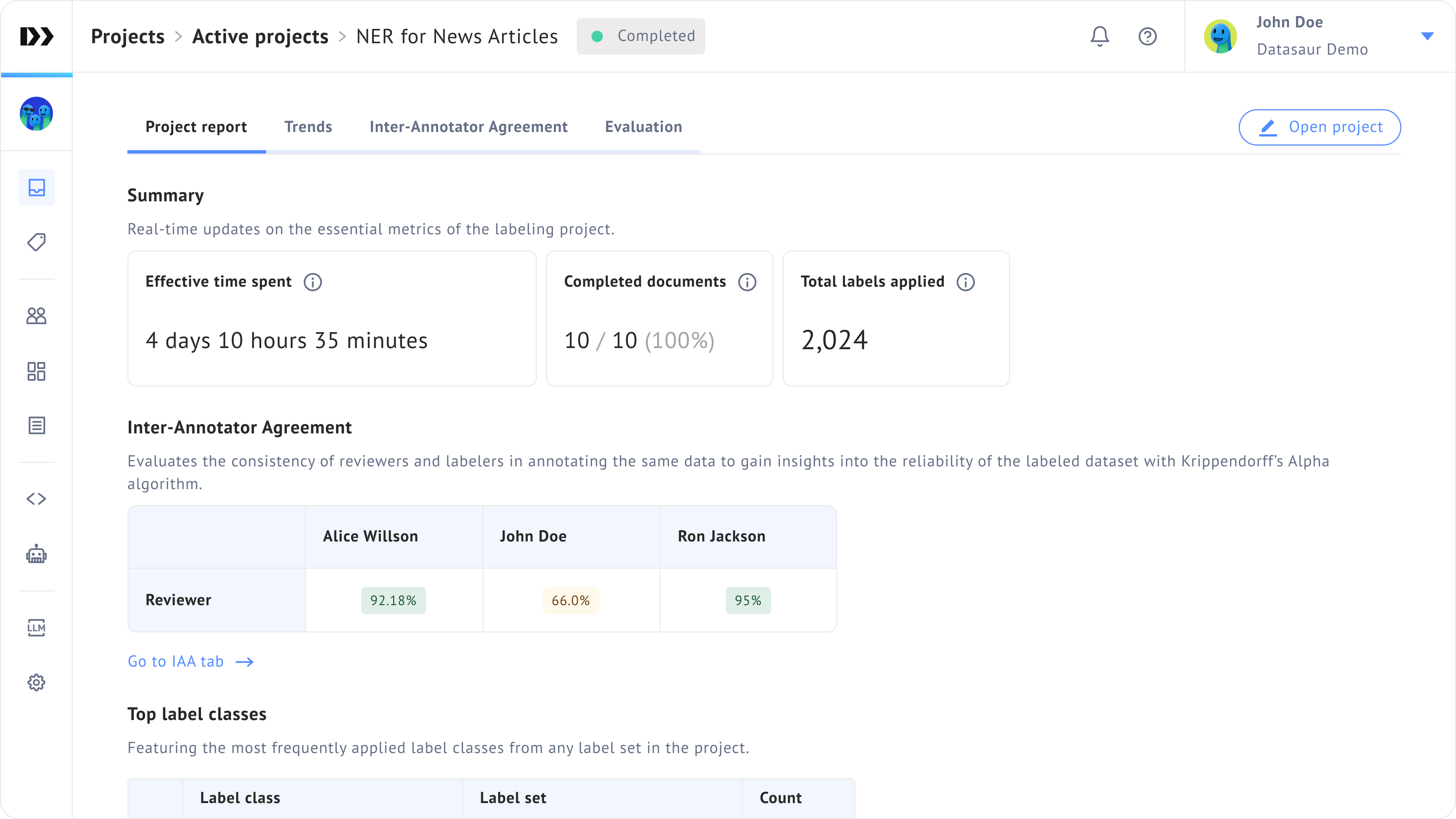
This tab provides a more comprehensive report on labeling results. All calculations are based on the reviewer mode of the project. Some metrics may be partially available if the project is not yet completed.
The report starts with the same metrics shown in the summary dialog. Each metric has a tooltip that explains how it is calculated.
It also includes an IAA (inter-annotator agreement) summary, highlighting agreement levels between reviewers and labelers.
Finally, the report displays the most frequently used label classes or most selected answers, depending on the project's labeling type:
* **Top label classes:** Available for both span and bounding box labeling.
* **Top selected answers:** Available for both row and document labeling. Only questions with predefined options are included (radio button, dropdown, and hierarchical dropdown).